The Ship’s Log

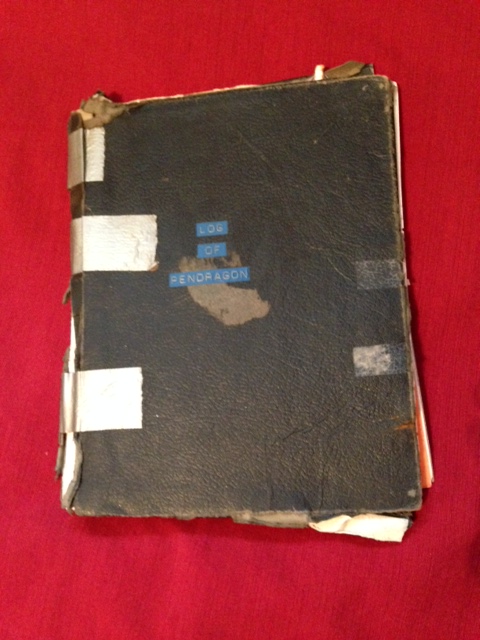
shipslog1Once I got home, I shared my excitement with one of my half-sisters, my father’s youngest daughter. At the time, she was visiting with her brother, my half-brother. When she told him what I had, he remembered he also had the original ship’s log from the journey and he offered to share it! Before the end of her visit, my sister sent it to me.

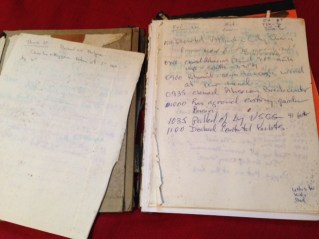
When the FedEx package arrived, I gingerly removed the thirty-seven year old log. After all these years, and significant time in the salt air, much of the glue has dissolved and the log has fallen apart. There is mold on the pages. Some of the ink and pencil has deteriorated, but most of it is still readable.

A ship’s log typically documents navigational and mechanical information. But, it turns out my father used the ship’s log as a combination log of the journey and a journal. I don’t speak “sailor” so I will need help translating some of the sailing passages. The journal-like entries add humanity to the content and when I read them, I learn a little about the father I never knew.
shipslog2Now I had my stepmother’s journals, official correspondence from after my father’s disappearance, letters he sent to his father during the journey, the private investigator’s report, and the ship’s log. No one person ever had all that information before!

But there was still that all important missing piece. How did the journey end? How was my father lost?

Before I started down this road, I shared my plans with my father’s other children, my half-siblings. I assured them what I would be writing would be fiction, loosely based on my father’s experiences. I wanted to be sure I had their approval before I began. Each gave their blessing. Along the way, each has also shared memories and materials. In turn, I’ve shared what I’ve discovered.

If you enjoyed this post, please consider subscribing to my blog using the link on the right side of the page at the top.

And Then I Found . . .

Shortly after committing to NaNoWriMo, I left town for a week long conference. After the event, I planned a visit a nearby cousin afterward. Since she is the daughter of my father’s sister, I shared my writing plans with her.

As we talked, she mentioned she might have some information that would be helpful. Her mother had been the keeper of all the family documents once our grandfather was gone. When her mother downsized, my cousin took possession of everything.

Together, we went through some of the boxes in her attic. We came upon a treasure trove – letters sent by my father to his father during the journey. There were seven of them and they provided a wealth of information about his route, his schedule, and, most importantly, about his feelings. They are fascinating and will be invaluable to me in my writing. I scanned the letters with my portable scanner.

She also had a copy of the report from the private investigator who was hired by my grandfather after my father disappeared. I wanted to scan that, too, but it was held together by a rusty staple I was reluctant to remove. She encouraged me to take the report and the letters home. I was eager to read everything!

NaNoWriMo

nanowrimologoLast year, a colleague introduced me to National Novel Writing Month (NaNoWriMo). Each November, over 300,000 people worldwide attempt to write a 50,000 word novel in a month. That works out to 1,667 words per day, every day for 30 days.  The four day weekend that is Thanksgiving falls in November, last year ending on November 30. We drive ten hours each way to spend the holiday with family.

I was reluctant to participate because I’m highly competitive and I wasn’t comfortable making a commitment like that and not finishing. I also knew that besides Thanksgiving, I was going to be out of town for two weeks. I could write a lot of that time, but some of it was vacation and I had to take the rest of my family into consideration.  Still, in early October, I took the plunge and signed up for NaNoWriMo. Then I left for a weeklong conference.

As I found out later, of the 300,000 who sign on, approximately 12-14% actually get to 50,000 words. People who do finish are considered winners. I knew that not everyone made it, but I’m glad I didn’t know the success rate was as low as it is. I think I might have given myself permission to not finish. As it was, I didn’t consider coming up short an option. (Note to self: forget those statistics for next time!)

Once I made the commitment, I had to figure out what I was doing. Writers will tell you there are essentially two kinds of writers: plotters and pantsers. Plotters plan ahead, figuring out how the story will go, preparing character studies, determining settings, and creating an outline. On the other hand, maybe they have a vague idea of their story or a character whispering in their ear, but mostly pantsers sit down to write ‘by the seat of their pants.’

People who know me realize I would be a plotter. Unfortunately, the schedule I committed to did not afford me the luxury of a month or more of planning. I had the beginning of a story idea and some characters and some scenes in mind. Mostly, though, I would be writing by the seat of my pants. At the end of November, I hoped to have a 50,000 word rough draft. A very rough draft, but at least a start.

For more information about NaNoWriMo, visit nanowrimo.org.

The Wheels Started to Turn

The idea of writing a book rolled around in my head for a couple of months. How much did I know? Who could tell me more? My father disappeared in 1977. That was a long time ago.

I know nothing about the Bahamas. I don’t know much about New England where he spent most of his life. And, by the way, I didn’t even know my father.

I left the box on the floor of my office, unopened, for most of two months. Then, in late September, I pulled it out and went through what I had. Once again, I was taken by the story, the reality and the potential. The reality is my heritage, unrealized and forever unknown.

The potential, though, called to me. That was real. The immediate problem was that I’ve never written fiction. I would have to make up a lot of the story, as well as the characters in it.gears

Thinking of the project that way actually made it seem more approachable. I did have some rough information as a foundation. I would invent what I didn’t know and create the people myself. I knew I would alter many of the facts I did have to protect the privacy of the people who are still around.

The wheels were starting to turn.

The Seed was Planted

Last summer, I came in contact with journals written by the wife my father divorced shortly before embarking on his journey. Scattered through the boxes were copies of important papers regarding the boat and the official police report of finding it unmanned, aground. There were many letters between assorted attorneys and paperwork about the salvage of the boat. A preliminary report of death from the State Department was at the bottom of the box.seedling

As I read through the paperwork, I realized, here’s a story. If I were to write it, I knew I would have to write it as fiction because there is so much I don’t know, no one knows. I would have to invent a lot of the story. The seed was planted.


If you enjoyed this post, please consider subscribing to my blog using the link on the right side of the page.

Photo credit: http://www.123rf.com

Follow the Journey

Last summer, I happened upon information about a story I believe bears telling. Ten years ago, I discovered the father I never knew was lost at sea in 1977. Over the last few months, I’ve learned a lot about the man I never knew. What no one knows is what actually happened when he disappeared.

old documentsAn abundance of information has come to me from several sources. It was serendipity, really. I still don’t know what happened to my father. What I do know is the information I have makes a strong basis for a good story.

So many people have been intrigued by my experience that I’ve decided to share my journey turning the information I have into a novel. By profession, I write non-fiction. I’m a personal historian. I’ve never written fiction. With my novel, I’ll be making up much of the story as I go.

In this blog, I’ll share the ups and downs, successes and failures as they happen. When we’re done, you’ll be able to read the finished product, knowing the backstory of how it came to be. Likely, I will turn to readers for opinions or advice as I go.

This, then, is my invitation to you: follow the journey!


If you enjoyed this post, please consider subscribing to my blog using the link on the right side of the page.


Photo Copyright: http://www.123rf.com